Priority Aminos
account
$0.00 0

Cart

No products in the cart.

๐Ÿšš FREE SHIPPING OVER $200.00 ๐Ÿšš
**iN PROGRESS - aDDING COAS TO PRODUCT PAGES - bE PATIENT**
Bpc 157 tb 500 mix research overview priority aminos

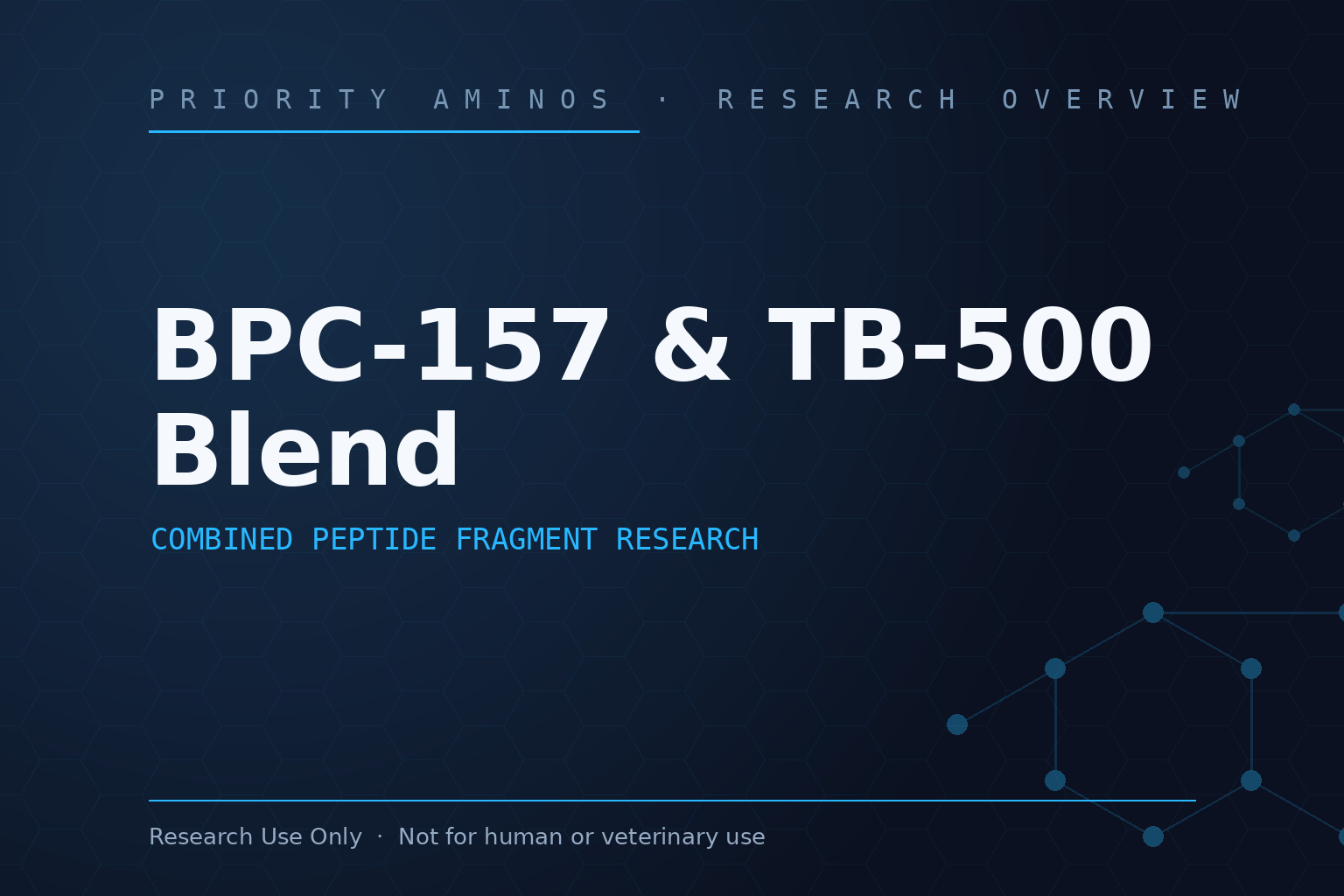
BPC-157 & TB-500 Blend Research Overview: Combined Peptide Fragment Research and Laboratory Interest

Posted: September 2026

Introduction

This blend pairs BPC-157, a gastric-derived pentadecapeptide fragment, with TB-500, an actin-sequestering peptide fragment, as a single combined-stack research product. Pairing two structurally distinct fragment peptides has made this blend a frequently referenced combination in comparative tissue-research programs.

This overview is intended for educational and research information purposes only.


Research Overview

Laboratory interest in the BPC-157 & TB-500 blend centers on comparative research between two structurally distinct fragment peptides studied together as a stack.

Researchers frequently examine:

  • Gastric-derived pentadecapeptide (BPC-157) structural research
  • Actin-sequestering peptide (TB-500) structural research
  • Combined-stack research-design models
  • Structural stability of each component in solution
  • Structure-activity relationships across both fragment classes

Studying two structurally distinct fragment peptides as a single combined stack allows researchers to compare their individual structural and stability profiles within one research design.

Comparative researchers frequently examine how combined-stack research designs pairing fragment peptides may relate to tissue-research models more broadly.

Research interest frequently includes:

  • Combined-stack research-design comparative studies
  • Fragment-peptide structural research
  • Component-stability comparative research
  • In vitro structural-stability research

Comparative Research

Researchers frequently compare BPC-157 & TB-500 Blend with other research peptides to evaluate:

  • Structural differences between research peptides
  • Origin and design differences (natural, synthetic, or fragment-derived)
  • Stability across storage and handling conditions
  • Documentation and traceability requirements across a research program

Storage & Handling Considerations

Consistent handling procedures support research reproducibility:

  • Store lyophilized vials refrigerated or frozen per your lab’s protocol until reconstitution
  • Minimize repeated freeze-thaw cycles once reconstituted
  • Follow institutional handling procedures and PPE requirements
  • Dispose of materials per applicable institutional guidelines

Frequently Asked Questions

What Is BPC-157 & TB-500 Blend Intended For?

BPC-157 & TB-500 Blend is supplied for laboratory research applications and educational research purposes only.

Is BPC-157 & TB-500 Blend Intended For Human Use?

No. Research materials supplied by Priority Aminos are not intended for human or veterinary use.

Why Are Lot Codes Important?

Lot coding supports traceability, documentation, and internal quality procedures.

Why Do Researchers Compare Similar Compounds?

Comparative analysis may help researchers evaluate differences in structural origin, stability, and research-model design.

Why Are Storage Procedures Important?

Consistent storage procedures help maintain documentation standards and improve research consistency.


Related Research Topics


Research Use Only (RUO). Not for human or veterinary use.
    Priority Aminos
    Priority Aminos LLC supplies high-purity peptides for Research Use Only (RUO) to qualified laboratories. We focus on compliance, traceability, and dependable operations.
    ยฉ 2026 Priority Aminos LLC ยท Dunedin, FL 34698
    All products Research Use Only. Not for human or animal use.
    These products are not drugs, foods, dietary supplements, cosmetics, or medical devices and are not intended to diagnose, treat, cure, or prevent any disease. For lawful laboratory research use only by qualified researchers.